





Cycling bridge Rüdesheim - Bingen
There are no rivers along the Rhine between Mainz and Koblenz.
The bridge. Although there are ferry services, they cease to operate at low tide.
In view of the already detectable climate change, this situation will become even more frequent in the future.
to be reckoned.
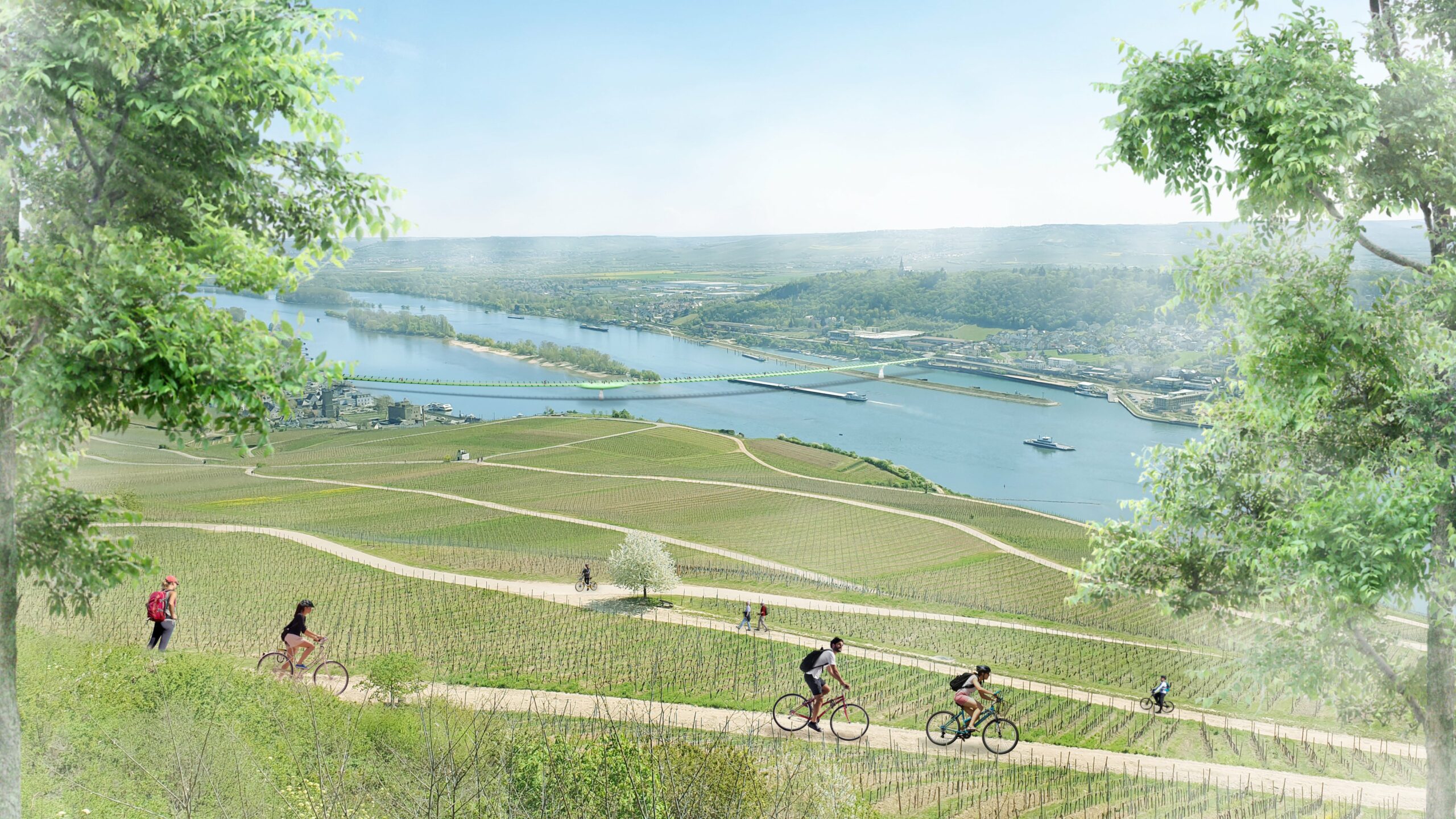
Rheinbrücke Bingen Visualization | © Rheingau.de
Either way, a cyclist and pedestrian bridge could look like this (see figure). Unlike the repeatedly discussed projects for car bridges across the Rhine, the ‘Green Wave’ would be a much lighter construction. Currently, a location is favoured that would connect the two stations of the two cities within walking distance and thus also represent a perfect link for pedestrians and cyclists between the two transport networks. At the same time, the ecological and financial burdens are considerably lower than for a bridge for car traffic.
For a foot/wheel bridge there are various funding programs of the federal government and also of the EU. Here are funding quotas of up to 90% possible. ADFC Hessen has already welcomed the construction of a cyclist's bridge in 2020.
According to the Allgemeine Zeitung, in July 2022, the city council of Bingen decided to launch a feasibility study on a wheel bridge only if Rüdesheim is also involved. But that is now questionable.
According to the Green Wave Working Group, the current position of the Rheingau-Taunus circle is currently unclear. On 31.5.2021, the district committee recommended to the district council to have the feasibility of a foot/wheel bridge checked. The district council did not follow this recommendation and would like to continue to achieve the construction of a classic car bridge.
 English (US)